An empire that had lasted over a thousand years fell in a single morning. When Constantinople’s walls finally broke, the shockwaves reached far beyond the city itself, reshaping trade, scholarship, and the map of Europe.

Timeline
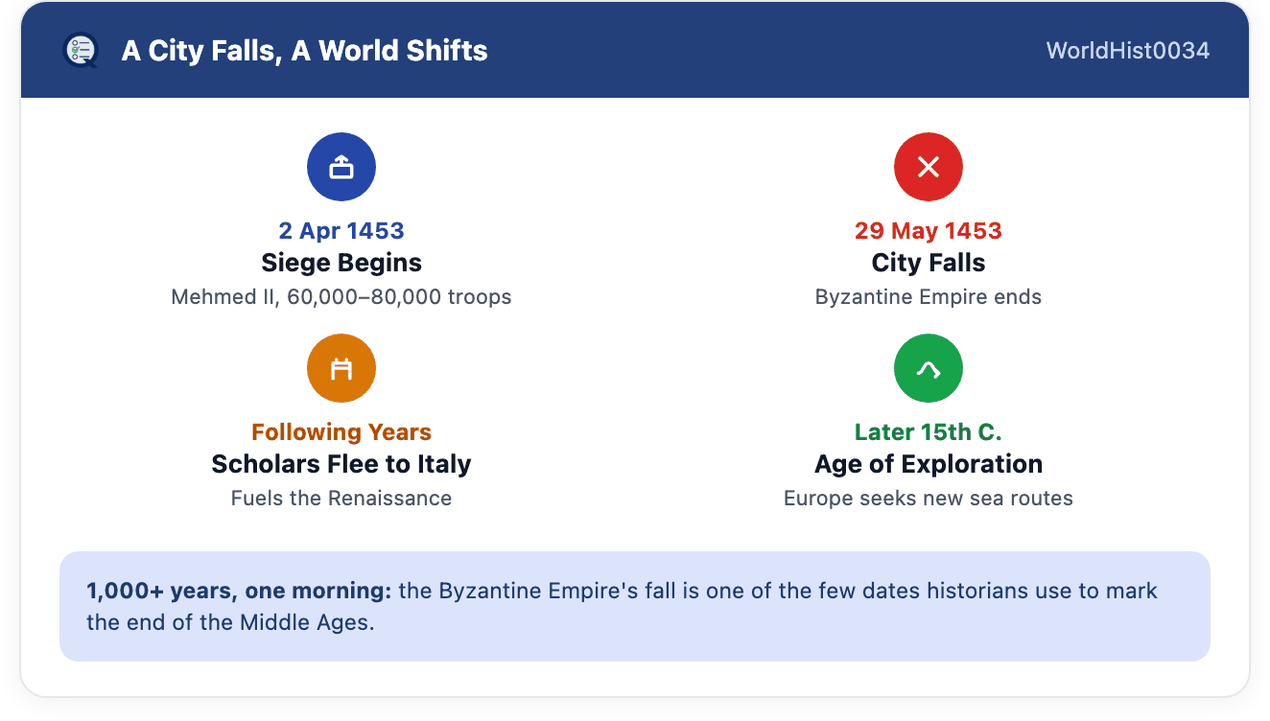
- 2 April 1453: Ottoman Sultan Mehmed II begins his siege of Constantinople.
- 29 May 1453: The city falls, after nearly two months under siege. Emperor Constantine XI dies defending it.
- Following years: Greek scholars flee to Italy with classical manuscripts, feeding into the Renaissance.
- Later 15th century: Ottoman control of overland trade routes pushes European powers to seek new sea routes, helping launch the Age of Exploration.
Must Know
- Constantinople fell to the Ottoman Empire on 29 May 1453, ending the Byzantine Empire after more than a thousand years.
- The siege was led by Ottoman Sultan Mehmed II, then just 21 years old. His forces, numbering 60,000 to 80,000, used powerful cannon to breach the city’s famous walls.
- The Byzantines, defending with only around 7,000 troops, were badly outnumbered. The last Byzantine Emperor, Constantine XI, died fighting during the final assault.
- Mehmed II made Constantinople his new capital. Many historians mark 1453 as a conventional dividing line between the Middle Ages and the early modern period.
- The fall disrupted traditional overland trade routes to Asia, pushing European powers toward new sea routes and helping launch the Age of Exploration.
Good to Know
- By the time of the siege, the Byzantine Empire had shrunk to little more than Constantinople itself and a handful of scattered territories.
- The Ottomans deployed massive cannon, including one nicknamed the “Royal Gun,” specifically built to break through the city’s ancient walls.
- Only around 2,000 of the city’s defenders were foreign allies, mostly Genoese soldiers sent to reinforce the Byzantines.
- Greek scholars fleeing the fallen city carried classical manuscripts to Italy. This influx of Greek learning is widely cited as a real contributing factor to the Italian Renaissance.
- With traditional land routes to Asia under Ottoman control, nations like Portugal and Spain intensified their search for sea routes instead. That search eventually led to Vasco da Gama’s route to India, and Columbus’s voyages westward.
Test Yourself

Great to Know
- The fall of Constantinople is one of a handful of dates historians use to mark the end of the medieval world. See WorldHist0033 — Treaty of Westphalia (1648) for another, roughly two centuries later, when Europe’s political order shifted again.
- A single military defeat rarely stays contained to just one place. Constantinople’s fall reshaped trade routes, sparked a wave of learning in Italy, and ultimately pushed Europe out toward open oceans.
Beyond the answer
Browse all world-history topics →
📚 Keep reading
Polity0368 — Right to the City: UN-Habitat and Urban RightsAncHist0078 — The Old Silk Route and Ancient Indian TradeGovernors-General and Viceroys of India (1773-1947)ModHist0004 — The Decline of the Mughal Empire: Causes Behind the CollapseLord Wellesley: The Subsidiary Alliance and the Conquest of India❓ Practice this topic
UPSC Mains 2017 GS1 Q4: Decolonization Problems in MalayaUPSC Mains 2016 GS1 Q7: West Africa's Educated-Elite NationalismC9287 — Which statement best describes what made Malaya's 1957 independence unusual compared to most other decolonization cases?C9286 — Malaya's Alliance Party that negotiated independence in 1957 was a coalition of UMNO, the MIC, and which third party?🎲 Take a World History Quiz
Leave a Reply