320. Functions of Public Service Commissions.—(1) It shall be the duty of the Union and the State Public Service Commissions to conduct examinations for appointment to the services of the Union and the services of the State respectively. (2) It shall also be the duty of the Union Public Service Commission, if requested by any two or more States so to do, to assist those States in framing and operating schemes of joint recruitment for any services for which candidates possessing special qualifications are required. (3) The Union Public Service Commission or the State Public Service Commission, as the case may be, shall be consulted—(a) on all matters relating to methods of recruitment to civil services and for civil posts; (b) on the principles to be followed in making appointments to civil services and posts and in making promotions and transfers from one service to another and on the suitability of candidates for such appointments, promotions or transfers; (c) on all disciplinary matters affecting a person serving under the Government of India or the Government of a State in a civil capacity, including memorials or petitions relating to such matters; (d) on any claim by or in respect of a person who is serving or has served under the Government of India or the Government of a State in a civil capacity, that any costs incurred by him in defending legal proceedings instituted against him in respect of acts done or purporting to be done in the execution of his duty should be paid out of the Consolidated Fund of India, or, as the case may be, the Consolidated Fund of the State; (e) on any claim for the award of a pension in respect of injuries sustained by a person while serving under the Government of India or the Government of a State in a civil capacity, and any question as to the amount of any such award. (4) Nothing in clause (3) shall require a Public Service Commission to be consulted as respects the manner in which any provision referred to in clause (4) of Article 16 or in Article 335 may be made or as respects the manner in which effect is to be given to any such provision.
UPSC’s advice isn’t binding. The government can reject it. But one constitutional clause specifically decides when the government doesn’t even have to ask. Article 320 maps out exactly what the UPSC and State Public Service Commissions do — and the reservation matters that sit outside their consultation net.
 MCQ Questions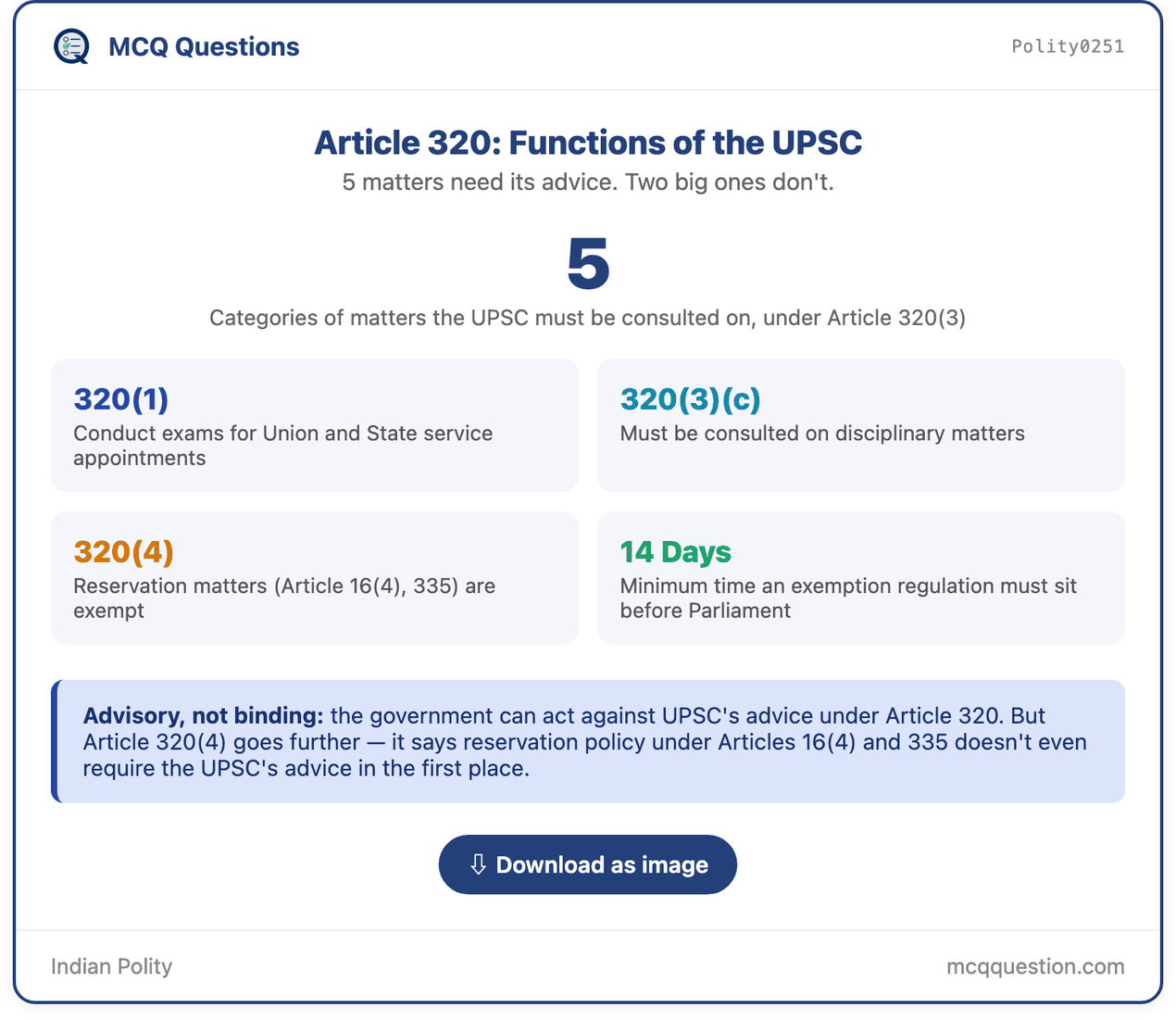
What Article 320 Does
- RoleArticle 320 defines the functions of the UPSC and State Public Service Commissions.
- Clause (1)Clause (1): Commissions conduct examinations for appointments to Union and State services.
- Clause (2)Clause (2): the UPSC can help 2 or more States frame a joint recruitment scheme, if they ask.
- Clause (3)Clause (3) requires consultation with the Commission on 5 categories of matters.
- Why it mattersTogether these clauses make the Commission the gatekeeper of merit in recruitment and the watchdog of discipline — so personnel decisions stay independent of politics.
The Five Consultation Matters
- Matter 1How people are recruited — the method of recruitment. The Commission checks that hiring follows fair, uniform rules so no department can invent its own shortcuts.
- Matter 2Appointment, promotion and transfer principles. These are where favouritism creeps in, so the Commission must be consulted to keep merit the test.
- Matter 3Disciplinary matters against civil servants. Because punishing an officer can be politically tempting, the Commission guards due process.
- Matter 4-5Defence-cost claims and injury pensions. These two protect the servant: the cost of defending a case, and pension for service injuries — both routed through the Commission.
- WhyWhy these five? They are exactly the areas where an executive could reward or punish officials unfairly — so the Constitution forces the impartial Commission into the loop.
The Exemption Proviso
- ProvisoA proviso lets the President, or a Governor, exempt certain matters from this consultation requirement.
- Clause (5)Clause (5) requires such exemption regulations to be laid before Parliament, or the State Legislature, for at least 14 days.
- WhyThe laying requirement keeps the exemption power transparent and subject to legislative scrutiny.
- TakeawayExemptions exist, but they must be laid before the legislature.
Reservation Matters Are Exempt
- Clause (4)Clause (4) says Commission consultation is NOT required for matters under Article 16(4) or Article 335.
- 16(4)Article 16(4) covers reservation in public employment.
- 335Article 335 covers SC/ST claims, balanced against administrative efficiency.
- Why it mattersReservation policy decisions can bypass UPSC consultation entirely, by explicit constitutional design.
Work through a 5-question chain on Article 320, then keep practising with a random Indian Polity question.
Advisory, Not Binding
- RuleThe UPSC’s advice under Article 320 is advisory, not binding on the government.
- EffectThe government can act against the UPSC’s advice.
- WhyThe framers kept it advisory so the government retains final authority over personnel decisions.
- CostActing against advice without good reason still invites real public and parliamentary scrutiny.
- So whatThe Commission advises; the government decides — but must justify divergence.
Article 320 vs Article 315
- Article 315Article 315 creates the UPSC and State PSCs — their establishment.
- Article 320Article 320 defines what these Commissions actually do — their functions.
- RelatedArticle 316 covers their composition, and Article 317 their removal.
- WhyDon’t confuse creation (315), composition (316), functions (320) and removal (317).
- TakeawayFunctions = Article 320 is the exam-ready pairing.
Why the Consultation Exists
- PurposeMandatory consultation protects merit and impartiality in the civil service.
- MechanismBy routing recruitment and discipline through the Commission, the framers kept politics out of personnel decisions.
- WhyA neutral Commission shields officials from executive favouritism or vindictiveness.
- So whatArticle 320 is part of the constitutional machinery guarding the steel frame of the civil service.
- TakeawayThe consultation rule is a merit safeguard: it makes the executive justify deviations from impartial advice.
Structural Independence of Commissions
- DesignThe UPSC and State PSCs are designed with structural independence — their members serve fixed terms and can only be removed by a rigorous process.
- WhyIndependence from the government lets the Commission give unbiased advice on recruitment and discipline.
- LinkThis independence underpins Article 320’s consultation role — the advice is credible because the body is independent.
- So whatThe Commission’s value rests on its independence from the executive it advises.
- TakeawayA Commission that cannot be easily removed is one that can genuinely advise against the government.
The Exam-Angle Takeaway
- Five mattersRecruitment, appointment/promotion/transfer, discipline, defence costs, injury pensions — 5 areas of mandatory consultation.
- Two exemptionsReservation under 16(4) and SC/ST claims under 335 need no consultation.
- AdvisoryThe advice is not binding; exemptions need 14-day legislative laying.
- WhyThese precise numbers and exceptions are what examiners test.
- So whatMemorise: 5 matters, 2 exemptions, advisory advice, 14-day laying.
Article 320(4): Reservation Exempt from Consultation
- QuestionUnder Article 320(4), consultation with the Public Service Commission is NOT required for matters relating to what? Correct answer: reservation in public employment under Article 16(4).
- WhyArticle 320(4) exempts matters under Article 16(4) (reservation) and Article 335 (SC/ST claims) from mandatory consultation. Recruitment, discipline and pensions require it under 320(3).
- LinkTest it: Article 320(4) question.
The ‘Which Article’ Question
- Fact testedThe UPSC functions under Article 320; Article 315 creates it, Article 316 covers composition.
- TrapConfusing 315 (creation) with 320 (functions).
- TryFunctions = Article 320.
The ‘How Many Matters’ Question
- Fact testedArticle 320(3) requires consultation on 5 categories of matters.
- TrapOptions saying four or six are wrong.
- TryRecruit, appoint, discipline, defend, pension — five.
Why UPSC Consultation Is in the News
- DevelopmentDebates over lateral entry, exam conduct and reservation often centre on how much the UPSC is (or isn’t) consulted.
- Why it mattersArticle 320 defines that consultation boundary — so current personnel-policy stories map back to it.
- So whatWatch UPSC news through the lens of Article 320’s five consultation matters.
Reservation Policy and the Commission
- DevelopmentBecause Article 320(4) exempts reservation from consultation, government reservation decisions can proceed without UPSC input.
- Why it mattersThis is a deliberate design — politically sensitive reservation choices stay outside the Commission’s mandatory net.
- So whatAny question on reservation bypassing UPSC consultation ties directly to Article 320(4).
Beyond the answer
Browse all indian-polity-and-constitution topics →
📚 Keep reading
UPSC CSP 2024 — General Studies Paper I (Full Question Paper)UPSC CSP 2025 — General Studies Paper I (Full Question Paper)UPSC CSP 2026 — General Studies Paper I (Full Question Paper)UPSC CSP 2017 — General Studies Paper I (Full Question Paper)UPSC CSP 2022 — General Studies Paper I (Full Question Paper)❓ Practice this topic
What does Article 75(1A) of the Constitution, inserted by the 91st Amendment, specifically cap?How does a sitting Vice-President of India resign from office?Which landmark Supreme Court case first established the Basic Structure doctrine?Under international law, what is the precise legal test that defines an act as 'piracy'?🎲 Take a Indian Polity And Constitution Quiz
Leave a Reply