In June 2026, India validated its ability to intercept a missile nearly 5,000 km away. That puts India in a very small club of nations with any defence against that missile class. This article covers India’s Ballistic Missile Defence programme — its own interceptors, and the imported S-400 system alongside them.

Timeline
- December 2021: India’s first S-400 squadron becomes operational, deployed in Punjab.
- 2 November 2022: DRDO’s Phase-II BMD interceptor AD-1 has its maiden flight test.
- Late March 2026: India’s Defence Acquisition Council approves 5 additional S-400 squadrons, under “Mission Sudarshan Chakra.”
- 10-11 June 2026: Flight tests of AD-1, AD-2, and NASM-MR validate India’s ability to intercept ICBM-class missiles.
Must Know
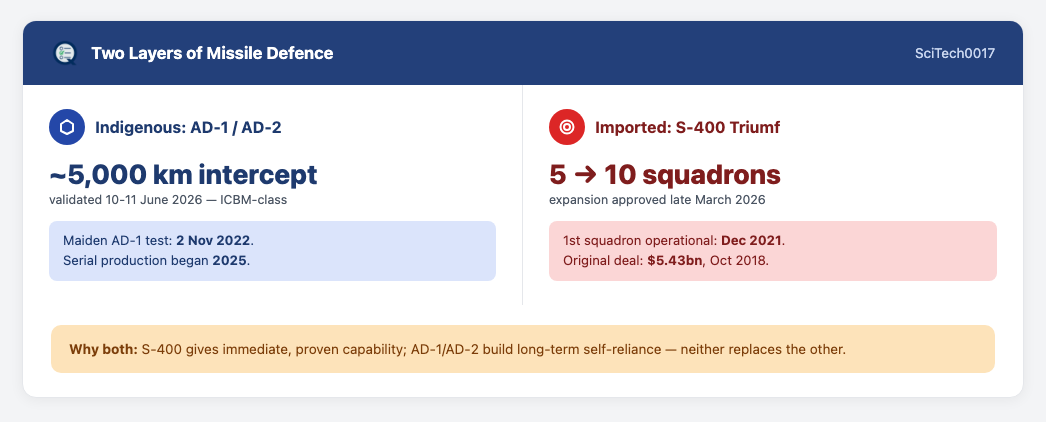
- India’s Ballistic Missile Defence (BMD) programme has two layers: DRDO’s indigenous Phase-II interceptors (AD-1, AD-2), and Russia’s imported S-400 Triumf system.
- India’s first S-400 squadron became operational in December 2021, deployed in Punjab.
- DRDO’s AD-1 interceptor had its maiden flight test on 2 November 2022, from Dr APJ Abdul Kalam Island, Odisha.
- On 10-11 June 2026, three flight tests (AD-1, AD-2, NASM-MR) validated India’s ability to intercept missiles with ranges approaching 5,000 km — ICBM class.
Good to Know
- The original S-400 deal, signed with Russia in October 2018, covers 5 regiments at a cost of $5.43 billion.
- In late March 2026, India’s Defence Acquisition Council approved a package worth about $28-30 billion, including 5 additional S-400 squadrons — potentially doubling India’s total to 10 units by 2035.
- Limited serial production of the AD-1 interceptor began in 2025, marking the shift from development to actual deployment.
- AD-1 is a two-stage, solid-fuel interceptor, designed to intercept long-range ballistic missiles and aircraft at both exo-atmospheric and endo-atmospheric altitudes.
Test Yourself

Great to Know
- India’s BMD strategy deliberately layers two different systems. An imported S-400 provides immediate, proven capability. An indigenous AD-1/AD-2 programme builds long-term self-reliance. Neither replaces the other — they cover different threat classes and timelines.
- Validating ICBM-class interception, up to roughly 5,000 km, puts India among a small group of nations with any defensive capability against that missile class. That’s a very different bar than intercepting shorter-range regional threats.
- Mission Sudarshan Chakra’s scale — potentially 10 S-400 squadrons by 2035 — signals BMD is shifting from a niche capability toward a layered, nationwide air-defence shield.
- For the offensive side of India’s missile capability, see SciTech0016 — Missile Technology Programmes. For the organisation behind these systems, see SciTech0011 — DRDO.
Current Affairs
- On 23 July 2026, DRDO flight-tested a third system: ‘Kusha’, a long-range surface-to-air missile. The maiden test launched from APJ Abdul Kalam Island, Odisha, intercepting a simulated high-speed, high-altitude target. (Source: PIB)
- Kusha is designed to counter fighter jets, missiles, drones, and large aircraft, across a wide range and altitude. It’s often described as India’s indigenous answer to the S-400. (Source: PIB)
- All its parts — missiles, radars, and command systems — were developed by DRDO labs and Indian industry partners. Officials said a successful system would end India’s import dependence on such missiles. (Source: PIB)
Beyond the answer
Browse all science-and-technology topics →
📚 Keep reading
UPSC CSP 2026 — General Studies Paper I (Full Question Paper)UPSC CSP 2024 — General Studies Paper I (Full Question Paper)UPSC CSP 2025 — General Studies Paper I (Full Question Paper)UPSC CSP 2023 — General Studies Paper I (Full Question Paper)UPSC CSP 2022 — General Studies Paper I (Full Question Paper)❓ Practice this topic
What does India's National Viral Hepatitis Control Programme aim to achieve by 2030?According to WHO, how does viral hepatitis's global death toll compare to HIV/AIDS?What can now cure most Hepatitis C infections, even without a vaccine?Since when has a Hepatitis B vaccine existed?🎲 Take a Science And Technology Quiz
Leave a Reply