One district in Chhattisgarh built over 2.8 lakh water structures in a single year. Villagers and gram panchayats did it themselves, with no outside contractors.

mcqquestion.com
Environment & Ecology · EnvEco0044
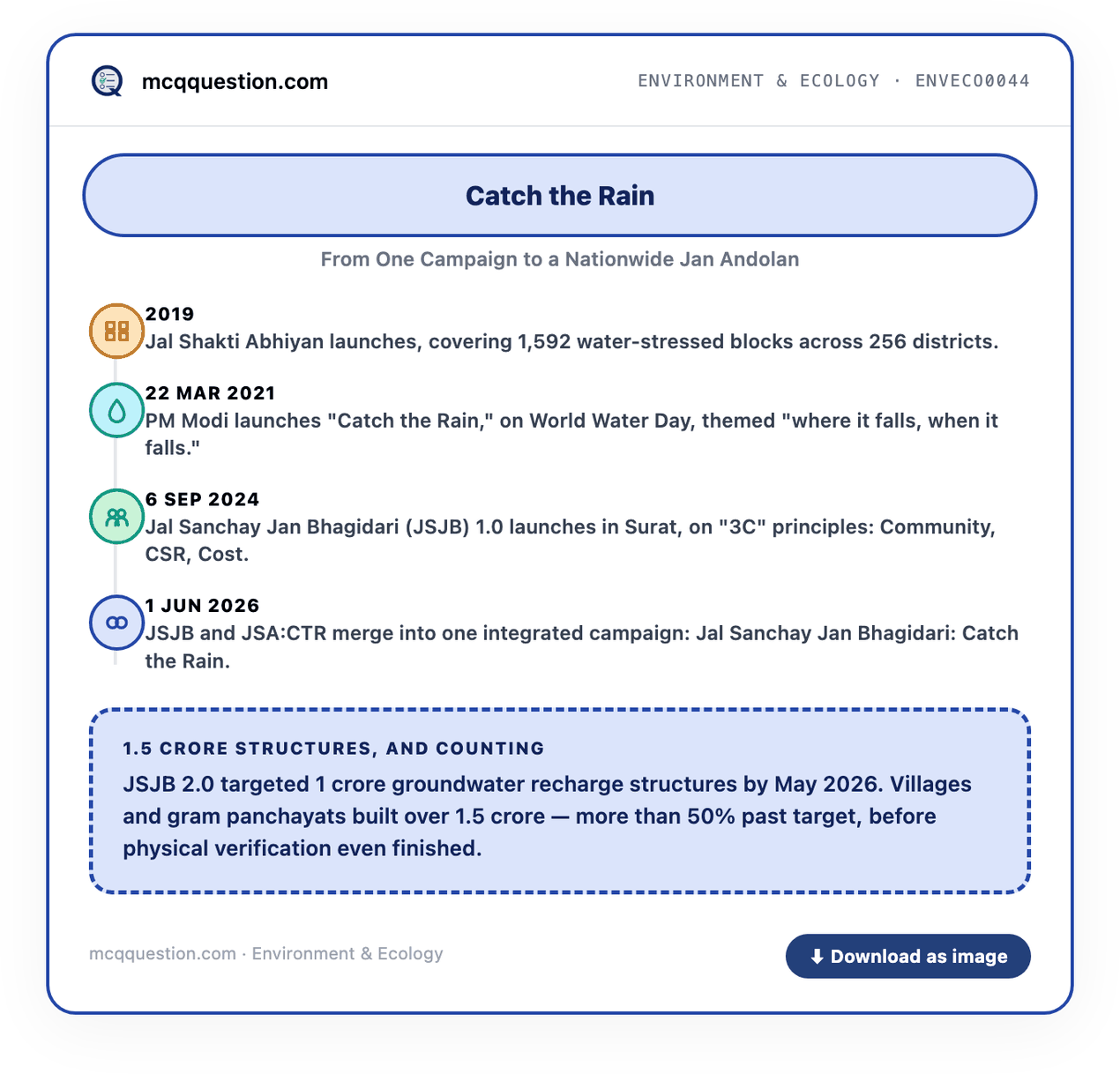
Catch the Rain
From One Campaign to a Nationwide Jan Andolan
2019
Jal Shakti Abhiyan launches, covering 1,592 water-stressed blocks across 256 districts.
22 Mar 2021
PM Modi launches “Catch the Rain,” on World Water Day, themed “where it falls, when it falls.”
6 Sep 2024
Jal Sanchay Jan Bhagidari (JSJB) 1.0 launches in Surat, on “3C” principles: Community, CSR, Cost.
1 Jun 2026
JSJB and JSA:CTR merge into one integrated campaign: Jal Sanchay Jan Bhagidari: Catch the Rain.
1.5 Crore Structures, and Counting
JSJB 2.0 targeted 1 crore groundwater recharge structures by May 2026. Villages and gram panchayats built over 1.5 crore — more than 50% past target, before physical verification even finished.
Must Know
- Jal Shakti Abhiyan: Catch the Rain (JSA:CTR) is a nationwide campaign for rainwater harvesting and groundwater recharge, run by the Ministry of Jal Shakti.
- It builds on the original Jal Shakti Abhiyan, launched in 2019. That campaign covered 1,592 water-stressed blocks, across 256 districts.
- PM Narendra Modi launched the “Catch the Rain” phase on World Water Day, 22 March 2021. Its theme was “Catch the Rain, where it falls, when it falls.”
- The campaign follows a Jan Andolan (people’s movement) model. It runs through gram panchayats, urban local bodies, and community groups, not top-down contracts.
- Since 2021, the campaign has run every year with a fresh focus. Themes have included source sustainability for drinking water (2023) and a women-led theme, “Nari Shakti se Jal Shakti” (2024).
Good to Know
- In 2024, the government layered on a second, related initiative: Jal Sanchay Jan Bhagidari (JSJB), launched on 6 September 2024 in Surat, Gujarat.
- JSJB runs on “3C” principles: Community participation, CSR (Corporate Social Responsibility) funding, and low-Cost, locally appropriate structures.
- JSJB 1.0 targeted at least 10 lakh groundwater recharge structures. It ended up with more than 27 lakh built, by 31 May 2025.
- JSJB 2.0 launched on 1 June 2025, targeting Over-Exploited and Critical groundwater districts specifically. Its target of 1 crore structures was exceeded by over 50%, with more than 1.5 crore reported.
- In 2026, the two tracks merged. Jal Sanchay Jan Bhagidari: Catch the Rain (JSJB:CTR) combined JSJB with the older JSA:CTR into one integrated campaign, launched 1 June 2026.
- Urban India runs a parallel track, under AMRUT 2.0. The Ministry of Housing and Urban Affairs (MoHUA) has mobilised over 900 Urban Local Bodies for it, across 27 States and Union Territories.
- The Prime Minister appealed for renewed effort in the 135th episode of Mann Ki Baat, on 28 June 2026. In response, the government ran a special, intensified one-month drive, from 4 July to 4 August 2026.
Test Yourself

Great to Know
- Jal Shakti Kendras (JSKs) are district-level knowledge and facilitation hubs. They give local communities technical guidance on water conservation methods.
- The government recognises standout performers through the Swachh Sujal Shakti Samman award, for women-led work in water conservation, sanitation, and hygiene.
- Under AMRUT 2.0’s Shallow Aquifer Management (SAM) Programme, 75 cities use recharge shafts, injection wells, and check dams, guided by scientific aquifer mapping.
- The campaign converges with several other schemes for funding and delivery, including Per Drop More Crop (PDMC) under PMKSY, CAMPA, and Finance Commission grants.
- Exemplary JSJB 1.0 performers were honoured at the 6th National Water Awards, held in November 2025.
- The Ministry of Jal Shakti runs two other major water programmes alongside this one. IndGov0039 — DDWS covers rural drinking water (Jal Jeevan Mission); EnvEco0023 — Namami Gange covers river rejuvenation.
Current Affairs
- 20 July 2026: MoHUA and the National Institute of Urban Affairs (NIUA) held a national interaction with all 75 AMRUT Shallow Aquifer Management (SAM) cities. Korba announced plans to revive 95 more defunct borewells; Nagpur committed to 100 more recharge structures this monsoon. (Source: PIB)
- 19 July 2026: PIB published a detailed backgrounder tracing the campaign’s full history. It confirmed JSJB 2.0 had already crossed 1.5 crore recharge structures, against its 1-crore target. (Source: PIB)
- 13 July 2026: The Ministry of Jal Shakti held its first “All India Water Secretaries’ Conference,” in New Delhi, chaired by Union Minister C.R. Patil. He called for the 2026 campaign to become a true people’s movement, with results uploaded to the JSJB: Catch the Rain 2026 Portal. (Source: PIB)
- 13 July 2026: The Ministry of Panchayati Raj began its first National Master Trainers’ Program on Water Budgeting. It is training panchayat-level trainers across 10 States, to help prepare local “Water Security Plans.” (Source: PIB)
- 13 July 2026: MoHUA reported over 900 Urban Local Bodies running rainwater harvesting and groundwater recharge work, under AMRUT 2.0. These span 27 States and Union Territories, with around 1.21 lakh acres of urban water bodies being revitalised alongside it. (Source: PIB)
- 10 July 2026: Balod, Chhattisgarh’s community-driven model was highlighted as a national example. The district built over 2.84 lakh water conservation structures in a year through Jan Bhagidari, including reviving a 14.3 km dried-up stream (nala). (Source: PIB)
- On 26 July 2026, Rajnandgaon, Chhattisgarh showcased its “Mission Jal Raksha” initiative. (Source: PIB)
- The district has built over 60,000 water conservation structures, across 662 villages. (Source: PIB)
- It has also converted 500-plus defunct borewells into recharge shafts. (Source: PIB)
- This work has generated over 51 lakh person-days of employment. (Source: PIB)
- Average groundwater levels there have risen by about 2.04 metres. (Source: PIB)
- On 25 July 2026, Andhra Pradesh’s Nandyal district reported strong campaign progress. (Source: PIB)
- It has grounded 2,103 water conservation works, across all 489 Gram Panchayats. (Source: PIB)
- The district also desilted 2,691 km of feeder channels, and restored 225 of 251 minor irrigation tanks. (Source: PIB)
- It has also built up a network of 22,221 farm ponds, and 2,221 check dams. (Source: PIB)
- On 23 July 2026, the Ministry reviewed AMRUT 2.0’s Shallow Aquifer Management (SAM) 2.0 progress. (Source: PIB)
- Under SAM 2.0, 870 sites have been mapped, and 539 project reports worth over ₹28 crore prepared. (Source: PIB)
- Separately, Korba, Chhattisgarh was hailed as a national model for the campaign. (Source: PIB)
- ISRO’s NRSC mapped 10 vulnerable recharge points there, each fitted with desiltation units and injection wells. (Source: PIB)
- A ₹111 crore NTPC wastewater partnership also backs Korba’s groundwater rejuvenation push. (Source: PIB)
- On 1 August 2026, PIB detailed Odisha’s Catch the Rain progress, following PM Modi’s 135th Mann Ki Baat call. The state ran 968 awareness activities, led by Khordha district’s 230. (Source: PIB)
- Odisha has completed 905 rainwater-harvesting and recharge structures. This includes 849 Rooftop Rainwater Harvesting structures, and 56 groundwater recharge shafts. (Source: PIB)
- The state has also taken up 98 traditional tanks for renovation and desilting, across all 30 districts. This restores storage capacity, for monsoon runoff and irrigation. (Source: PIB)
- On 31 July 2026, Vizianagaram district, Andhra Pradesh, was highlighted for Jan Bhagidari-driven groundwater revival, under the Jaladhara Jalaharathi programme.
- The district completed 8,973 water conservation works — rejuvenating 6,424 Minor Irrigation tanks and 2,549 feeder channels — generating 1.28 crore person-days of employment.
- Restoration removed 109.9 lakh cubic metres of silt and restored over 2,090 km of feeder channels, projected to add 0.70 TMC of storage and 0.60 TMC of groundwater recharge. Work prioritised 193 groundwater-deficit villages.
Leave a Reply