India doesn’t bury its spent nuclear fuel. It reprocesses most of it. That single choice shapes almost everything about how the country handles nuclear waste. This article covers India’s nuclear waste management — the closed fuel cycle, and the facilities that run it.

Must Know
A Closed-Cycle Policy
Closed Fuel Cycle, and Reprocessing Sites
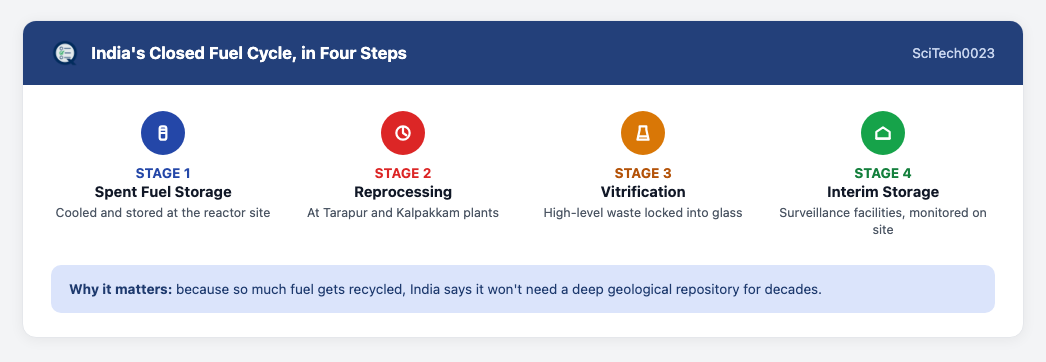
- PolicyIndia follows a closed nuclear fuel cycle. Spent fuel is reprocessed to recover reusable uranium and plutonium, not directly buried as waste.
- LocationReprocessing happens at plants in Tarapur and Kalpakkam, which handle spent fuel from India’s PHWR fleet.
Vitrification, and Scaling to 100 GW
- ProcessThe small fraction of waste left after reprocessing is vitrified — locked into an inert glass matrix — at plants in Trombay, Tarapur, and Kalpakkam.
- 29 Jan 2026The government told Parliament this closed-cycle strategy will scale to match India’s 100 GW-by-2047 nuclear capacity target.
Good to Know
Facilities and Research
New Facilities Under Construction, and Interim Storage
- BuildTwo new facilities are under construction. The Integrated Nuclear Recycle Plant (INRP) at Tarapur handles PHWR fuel. The Fast Reactor Fuel Cycle Facility (FRFCF) at Kalpakkam handles fast breeder reactor fuel.
- StorageVitrified high-level waste goes into Solid Storage Surveillance Facilities for monitored interim storage.
No Repository Needed Yet, and Partitioning Research
- PositionBecause so much fuel is recycled, India’s official position is that it won’t need a deep geological repository for several decades.
- ResearchResearch is underway on partitioning — separating out long-lived radioactive elements from waste, to shrink the volume that needs long-term storage.
✅ Test Yourself
Question 1 of 1
Great to Know
A Choice, Not the Only Path
Not the Only Option, and a Coming Capacity Test
- ContrastIndia’s closed-cycle approach is a real policy choice, not the only option. The United States, for instance, largely treats spent fuel as waste for direct, permanent disposal, rather than recycling it.
- StakesReprocessing and reactor expansion are linked. Scaling capacity toward 22,480 MW by 2031-32 and 100 GW by 2047 means far more spent fuel to reprocess. That will test whether existing capacity at just three sites can keep pace.
Why Private Reactors Still Need One System
- LinkThe SHANTI Act‘s private-sector opening makes centralised waste management more important, not less. Private reactor operators will still feed into the same national reprocessing and storage system.
- RelatedFor the policy reform reshaping India’s nuclear sector, see SciTech0021 — Nuclear Energy Programmes of India. For the reactor fleet itself, see SciTech0022 — Nuclear Reactors of India.
Where Reprocessing Began
- StoryIndia’s reprocessing programme began at Trombay. A demonstration plutonium plant there was commissioned in 1964, built to reprocess spent fuel from the CIRUS research reactor (GlobalSecurity.org).
- LinkThe plutonium recovered there fed directly into Smiling Buddha, India’s first nuclear test in 1974. That makes Trombay’s reprocessing plant the origin point for both the country’s civil and weapons programmes.
How Much Actually Becomes Waste
- NumberOnly about 2-3% of spent fuel ends up as true waste after reprocessing recovers the reusable uranium and plutonium (BARC). That’s the concrete number behind India’s “won’t need a repository for decades” claim.
The World’s First Permanent Repository
- ContrastFinland’s Onkalo facility is carved 430 metres into 1.9-billion-year-old bedrock. It’s set to become the world’s first operational deep geological repository, built to hold spent fuel safely for 100,000 years (Interesting Engineering).
- Why it mattersOnkalo exists because Finland’s open fuel cycle treats spent fuel as permanent waste. India’s closed cycle avoids needing an Onkalo-scale repository, at least for the next few decades.
PYQ
Exam Point of View
CAPF 2026: Nuclear Fuel Facts, and the Closed-Cycle Trap
- QuestionCAPF asked which statements about nuclear fuel are correct. All three are true: spent fuel is highly radioactive, fuel must be enriched before use, and a control-system failure can cause a meltdown.
- LinkSource: CAPF (ACs) 2026, General Ability and Intelligence (see Q101).
- WisdomA question describing “spent fuel treated as waste for permanent burial” is describing the US/open-cycle model, not India’s. India’s own approach is reprocessing and recycling, with burial reserved only for the small vitrified residue, not the bulk of spent fuel.
- Also watchDon’t confuse reprocessing (recovering usable uranium/plutonium) with vitrification (locking waste into glass) — they’re sequential steps, not the same process, and a question can test either term’s meaning separately.
Was this helpful?
Leave a Reply