India will release nearly 392,000 tonnes of microplastics into its waterbodies this year. Only China releases more. This article covers chemical threats to biodiversity — plastics and pesticides — how they move through food chains long after they’re released, and the exact PYQs built on these terms.

Must Know
Sources of Chemical Threat
- StoryChemical threats to biodiversity come from several sources: pesticides, plastics and microplastics, industrial effluents, and heavy metals.
India’s Microplastic Release
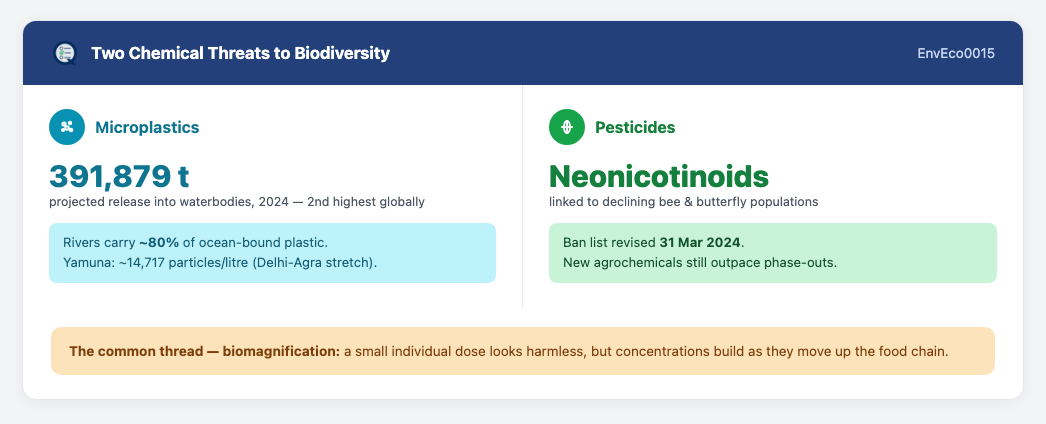
- DataIndia is projected to release about 391,879 tonnes of microplastics into waterbodies in 2024 — the second-highest amount globally, after China’s 787,069 tonnes.
Rivers as the Main Conduit
- DataRivers carry roughly 80% of all plastic that eventually reaches the ocean worldwide.
Pesticides and Pollinators
- StoryPesticides, especially neonicotinoids, are linked to declining bee and butterfly populations in India, weakening pollination and crop yields.
Good to Know
India’s Plastic Waste Footprint
- DataIndia generates about 4.13 million tonnes of plastic waste every year, domestically.
The Yamuna and Ganga Numbers
- DataA study across Delhi, Mathura, Haryana, and Agra found the Yamuna carrying an average of about 14,717 microplastic particles per litre, across 29 sampling points.
- DataIn Bihar’s stretch of the Ganga, sediment samples showed 99 to 410 microplastic items per kilogram.
Pesticide Regulation in India
- StoryIndia updates its list of banned, restricted, and refused pesticides regularly. The latest revision took effect on 31 March 2024.
✅ Test Yourself
Work through a 5-question chain covering India’s microplastic release, biomagnification, and pesticide-pollinator links, then keep practising with a random Environment and Ecology question.
Great to Know
Why These Threats Stay Invisible
- WhyChemical threats differ from threats like habitat loss. They’re often invisible until concentrations build up in the food chain — a process called biomagnification.
The Same Pattern, Twice
- StoryMicroplastics and pesticides both follow this pattern. A small individual dose looks harmless, but the effect compounds moving up the food chain, from plankton to fish to larger predators.
Regulation Lags Exposure
- InsteadPesticide bans get updated periodically, but new agrochemicals enter use faster than older ones get phased out.
- LinkFor pollution types and core ecosystem terms, see EnvEco0001 — Pollution, Ecosystems and Biodiversity. For India’s solid waste and e-waste systems, see EnvEco0011 — Solid and Hazardous Waste.
PYQ / Exam Angle
CAPF 2017: What Biomagnification Means
- QuestionCAPF (ACs) 2017 asked what the term Biomagnification refers to. The answer is the accumulation of an increasing amount of a non-degradable pollutant through the food chain.
- WhyEach predator accumulates the pollutant load of all the prey it eats faster than it can excrete it, so concentrations rise at each trophic level.
- LinkSource: CAPF (ACs) 2017, General Ability and Intelligence (see Q106).
CDS 2018: Bioaccumulation vs. Biomagnification
- QuestionCDS-I 2018 tested two statements distinguishing bioaccumulation from a food-chain example. The answer is that both are individually true, but the second does NOT explain the first.
- WhyBioaccumulation is build-up within a single organism over time; the fish-vs-plankton example instead describes biomagnification, a related but distinct process across trophic levels.
- LinkSource: CDS-I 2018, General Knowledge (see Q18).
Beyond the answer
Browse all environment-and-ecology topics →
📚 Keep reading
EnvEco0011 — Solid and Hazardous WasteUPSC CSP 2019 — General Studies Paper I (Full Question Paper)UPSC CSP 2024 — General Studies Paper I (Full Question Paper)UPSC CSP 2026 — General Studies Paper I (Full Question Paper)UPSC CSP 2023 — General Studies Paper I (Full Question Paper)❓ Practice this topic
How does permaculture farming typically compare to conventional chemical farming on soil salinity?Which fertilizer is NOT suitable for fertigation, since it is largely insoluble in water?Which of the following is NOT one of FAO's three real principles of Conservation Agriculture?In which year and city was the Global Alliance for Climate-Smart Agriculture (GACSA) launched?🎲 Take a Environment And Ecology Quiz
Leave a Reply