In June 2025, India crossed a target it hadn’t expected to hit until 2030. Half its installed power capacity now comes from non-fossil sources. Coal still generates most of the actual electricity, though — capacity and generation aren’t the same number. This article covers India’s energy resources, the gap between the two, and the exact PYQs built on these terms.

Must Know
Fossil vs. Non-Fossil Sources
- StoryIndia’s energy mix splits into fossil sources (coal, oil, natural gas) and non-fossil sources (solar, wind, large hydro, nuclear).
Panchamrit at COP26
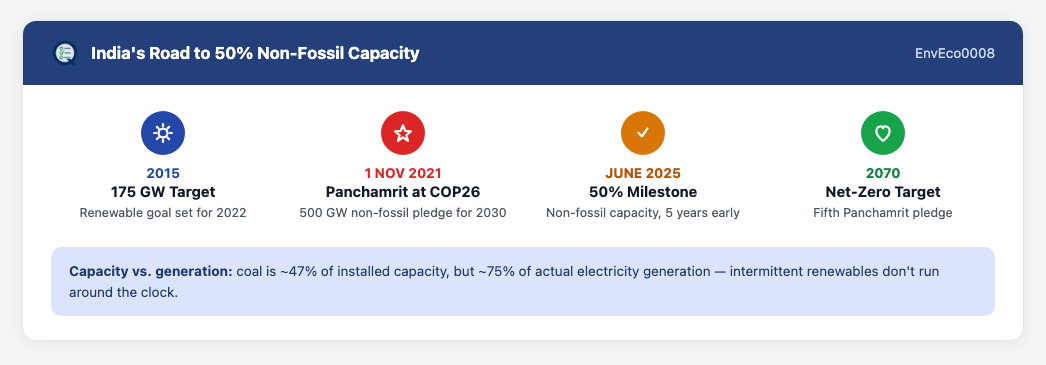
- StoryAt COP26, on 1 November 2021, PM Modi announced “Panchamrit” — five climate pledges, including 500 GW of non-fossil energy capacity by 2030.
The 50% Milestone
- ResultIn June 2025, India reached 50% of its installed power capacity from non-fossil sources — five years ahead of the 2030 target.
Coal’s Capacity-Generation Gap
- InsteadCoal still accounts for about 47% of installed capacity, but roughly 75% of actual electricity generation.
Good to Know
The 2015 175 GW Target
- StoryIndia had set an earlier target in 2015: 175 GW of renewable capacity by 2022 — 100 GW solar, 60 GW wind, plus biomass and small hydro.
The Other Panchamrit Pledges
- MechanismThe Panchamrit pledges also include cutting the economy’s carbon intensity by 45% below 2005 levels by 2030, and a net-zero target for 2070.
What Counts as “Non-Fossil”
- Instead“Non-fossil” covers more than wind and solar — nuclear and large hydro projects also count toward the same 500 GW target.
- HowSolar and wind make up the bulk of India’s renewable capacity, with solar the larger of the two.
✅ Test Yourself
Work through a 5-question chain covering the COP26 Panchamrit pledges, the 50% milestone, and the exact dates and figures behind them, then keep practising with a random Environment and Ecology question.
Great to Know
Why the Capacity-Generation Gap Matters
- WhyThe gap between coal’s ~47% share of capacity and ~75% share of actual generation is the key thing to understand here.
- MechanismSolar and wind are intermittent — they don’t run around the clock — so installed capacity overstates their real contribution to the grid.
A Capacity Milestone, Not a Generation One
- StoryHitting 50% non-fossil capacity five years early is notable, but it’s a capacity milestone, not a generation one.
- InsteadThe harder task ahead is making renewables reliable enough to actually displace coal’s generation share, not just its share of installed capacity.
Five Pledges, Five Different Metrics
- StoryThe 500 GW target is one number inside a five-part package. Capacity, carbon intensity, absolute emissions, and a 2070 net-zero date all pull in the same broad direction, but they measure different things.
- InsteadHitting one pledge doesn’t guarantee progress on the others.
- LinkFor how this fits into India’s wider climate framework, see EnvEco0002 — Climate Change, EIA and Renewable Energy.
PYQ / Exam Angle
CAPF 2026: The Real Net-Zero Year
- QuestionCAPF (ACs) 2026 asked which element is NOT part of India’s Panchamrit. The answer is “net zero emissions by 2047” — the real pledge targets 2070.
- WhyThe other three options in that question (50% renewables, 45% carbon-intensity cut, 1 billion tonnes emissions cut, all by 2030) are genuine Panchamrit pledges — only the net-zero year was swapped.
- LinkSource: CAPF (ACs) 2026, General Ability and Intelligence (see Q15).
CDS 2024: COP28 and “Net Zero by 2050”
- QuestionCDS-2 2024 asked which COP28 resolution is associated with “Net Zero by 2050.” The answer is the fossil fuel phase-out language.
- WhyThe COP28 “UAE Consensus” explicitly calls for “transitioning away from fossil fuels in energy systems… to enable the world to reach net zero emissions by 2050.”
- LinkSource: CDS-2 2024, General Knowledge (see Q120).
Beyond the answer
Browse all environment-and-ecology topics →
📚 Keep reading
UPSC CSP 2024 — General Studies Paper I (Full Question Paper)UPSC CSP 2026 — General Studies Paper I (Full Question Paper)EnvEco0053 — India's Climate Change Policy: LT-LEDS, NDCs, and the Path to Net-ZeroUPSC CSP 2023 — General Studies Paper I (Full Question Paper)UPSC CSP 2025 — General Studies Paper I (Full Question Paper)❓ Practice this topic
In Pew Research's 2025 global survey, roughly what median share of people in middle-income countries said they are willing to make at least some lifestyle changes to help address climate change?India's mineral security problem is mostly about which of the following, rather than a shortage of underground reserves?Roughly what share of India's total degraded land is concentrated in just nine states, including Rajasthan, Maharashtra, and Gujarat?Roughly how much employment has India's Bonn Challenge restoration work generated, alongside its ecological goals?🎲 Take a Environment And Ecology Quiz
Leave a Reply